
Home / Commodities / Tobacco
Export commodity
Deli wrapper leaf from North Sumatra prized for its fine texture and burn, alongside Temanggung and Lombok filler graded by leaf position for kretek and cigarette blends.
HS 2401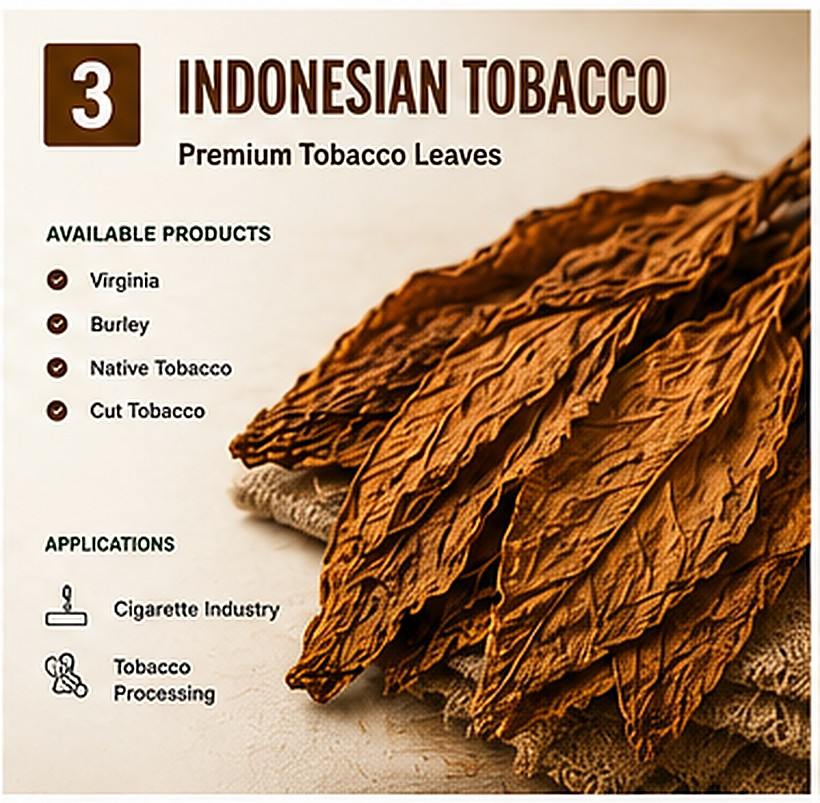
Overview
Indonesian tobacco occupies two quite separate places in world trade. Deli wrapper leaf from the plantation belt of North Sumatra has been sought by European cigar houses since the colonial era for its thin, fine-veined, elastic leaf and its even burn, qualities that are difficult to replicate elsewhere. Temanggung and Lombok filler, by contrast, is the aromatic backbone of the Indonesian kretek industry, grown at altitude and cured to carry a heavy, sweet aroma. We supply both, cured and graded by leaf position in the way Indonesian auctions and trading houses have always classified them, so the specification you agree matches what arrives.
Grades
Thin, elastic, fine-veined leaf graded by colour, size and freedom from damage. Selected for hand-rolled and machine-made cigar wrapping.
High-altitude aromatic filler with heavy body, the flavour driver in most kretek blends.
Volcanic-soil filler with a rounder, sweeter profile, commonly blended to soften a heavy Temanggung base.
Where it's grown
Post-harvest
Leaf is picked in priming order from the bottom of the plant upward, since each position carries different body and nicotine. It is then air-cured or sun-cured in open barns depending on type, bulked to even out moisture, and graded by hand into leaf-position classes. Grading is visual and manual, done by graders who have worked the same leaf for years. Bales are conditioned to 12 to 14% moisture before pressing, which is the range that keeps leaf pliable in transit without inviting mould.
Season
Tobacco is planted into the dry season and harvested roughly July to October, with curing and grading running through the following months. Contracting is usually done against the coming crop, so buyers who plan a season ahead secure both grade and price with far more certainty.
Who buys it
Deli wrapper leaf supplied cured and graded for hand-rolled and machine-made cigars.
Temanggung and Lombok filler for clove-cigarette manufacturers at home and abroad.
Bulk cured leaf for buyers running their own threshing and cutting facilities.
Packing, shipping & documents
Leaf is pressed into bales, typically 40kg to 80kg depending on type and buyer preference, wrapped and strapped for container loading. Because tobacco is a highly regulated commodity, shipments travel with certificate of origin, phytosanitary certificate, weight and quality certificate, and any import licence documentation your country requires. Import permits and excise arrangements are the buyer's responsibility, but we prepare the export-side paperwork and will work to your customs broker's checklist. Sample leaf is sent ahead so your blender can assess before the contract is signed.
Questions buyers ask
By position on the plant, meaning bottom, middle and top priming, then by colour, body and damage, following the grading conventions used by Indonesian tobacco auctions and trading houses.
Yes. Mixed containers combining Deli wrapper and Temanggung or Lombok filler can be arranged to match a specific blend requirement.
Air-cured and sun-cured leaf is standard. Fermented leaf can be arranged through partner curing facilities with additional lead time.
Certificate of origin, phytosanitary certificate, weight and quality certificate, packing list and commercial invoice. Import licences and excise obligations remain the buyer's responsibility.
Planting follows the dry season with harvest roughly July to October, and curing and grading continuing for months after. Most buyers contract against the coming crop.
Let's talk tonnage
Tell us your grade, volume, and destination port. We reply within one business day with an offer, samples, and lead time.
Other commodities