
Home / Commodities / Kapok Fiber
Export commodity
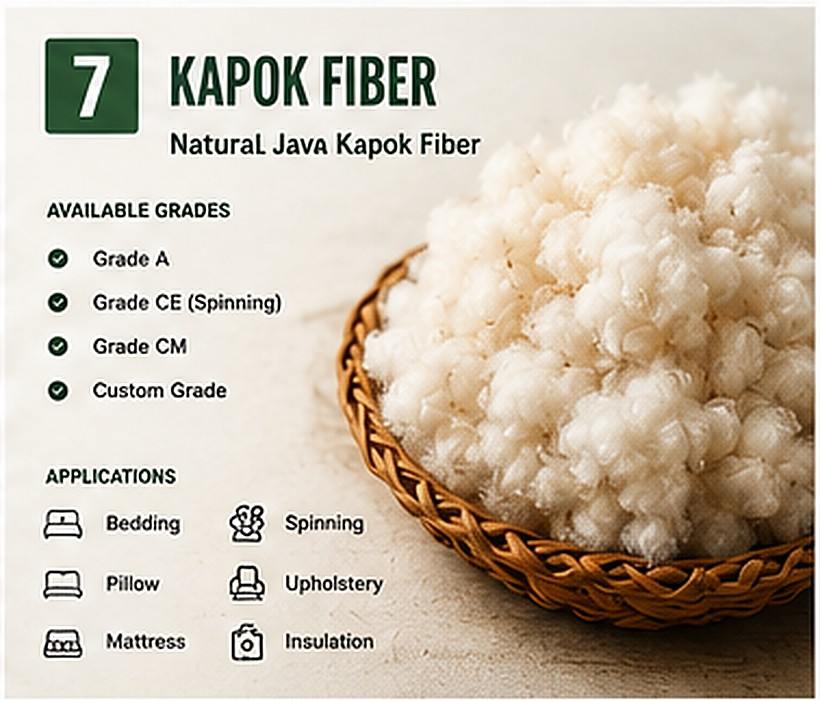
Natural Java silk-cotton fiber from the Ceiba pentandra tree. Hollow, feather-light and water-repellent, sun-dried, de-seeded and pressed into export bales.
HS 1404Full lab-tested specifications, grades and packing options: kapokfibersupplier.com →
Overview
Kapok is the floss inside the seed pod of the randu tree, and its value comes from a structure no synthetic fill has matched cheaply. Each fiber is a hollow, wax-sealed tube roughly four-fifths air, which makes it one of the lightest natural fibers known, naturally buoyant, and water-repellent while still absorbing oil. It filled the world's first life vests for exactly that reason. The tree is never cut to harvest it, needs no irrigation or spraying, and fruits for decades. Our family has worked kapok in East Java since 1979, and we ship it in pressed bales by the container.
Grades
Cleanest, whitest, best-lofted floss with low seed and impurity content. Specified for bedding, pillows and premium fill.
Economical bulk floss where top whiteness is not required. Used for stuffing, insulation and industrial fill.
Blended to your own ratio when the application needs a middle grade at a middle price.
Where it's grown
Post-harvest
Pods are gathered by hand in the dry season and sun-dried on racks until they split open. The raw floss is then fed through a gin that separates fiber from seed and shell, after which every sack is opened and hand-picked, the slow step no machine does properly. Sorted fiber is graded into A and B, moisture-checked against our safety data sheet specification, then compressed under hydraulic load into export bales, wrapped and strapped for the container.
Season
Kapok pods ripen and are gathered through the dry season, broadly June to October in East Java, with cleaning, grading and baling continuing afterwards. Because baled fiber stores well when kept dry, shipping is not tightly constrained by the harvest window.
Who buys it
Hypoallergenic, high-loft natural fill for mattresses, pillows and bolsters.
A breathable plastic-free thermal fill, and the original naturally buoyant life-vest fiber.
Water-repellent, oil-absorbing fiber used in spill cleanup and filtration media.
Packing, shipping & documents
Kapok ships in pressed bales of 25kg, 50kg or 100kg, wrapped in PP or cotton. Bale size drives your freight economics: a 40HC of 100kg bales carries about 18,000kg, roughly 2.4 times the fiber of the same container filled with 25kg bales, because larger bales press harder. Minimum order is one 20ft for 100kg bales. Kapok is a flammable solid classified UN 3360, IMO Class 4.1, Packing Group III, and we ship it as properly declared dangerous goods with a full safety data sheet on every order.
Questions buyers ask
Our dedicated site kapokfibersupplier.com carries full lab-tested specifications, grade comparisons, packing options and container loading calculations.
From one 20ft container for 100kg bales, or one 40HC for smaller 25kg and 50kg bales. Mixed Grade A and B is available on request.
Yes. Kapok is a flammable solid under UN 3360, IMO Class 4.1, Packing Group III, and is shipped with full dangerous goods declaration and a safety data sheet.
Larger bales are pressed harder, so a 40HC of 100kg bales holds roughly 2.4 times the fiber of the same container loaded with 25kg bales, cutting cost per kilo sharply.
The randu tree is never felled to harvest, grows without irrigation or pesticide on land that supports little else, and keeps fruiting for decades. The fiber itself is fully biodegradable.
Let's talk tonnage
Tell us your grade, volume, and destination port. We reply within one business day with an offer, samples, and lead time.
Other commodities