
Home / Commodities / Cinnamon / Cassia
Export commodity
Korintji cassia from the Kerinci highlands of Jambi, one of the world's most widely traded cinnamon-type spices, supplied as sticks, quills, broken bark or ground powder.
HS 0906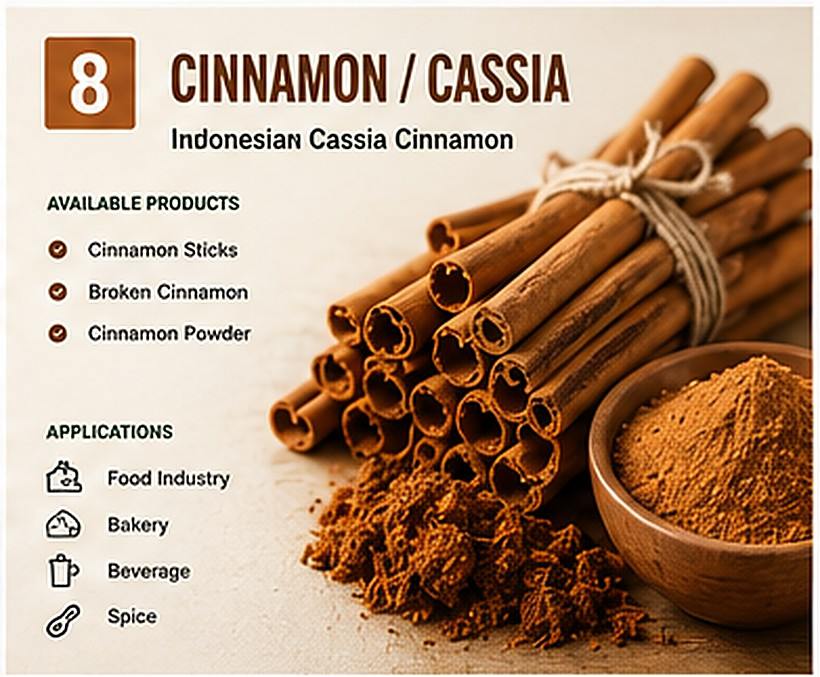
Overview
Most of what the world buys and calls cinnamon is in fact cassia, and a large share of that cassia comes from one highland district in Sumatra. Korintji cassia, Cinnamomum burmannii, grown around Kerinci in Jambi, is valued for a high volatile oil content and the strong, sweet, unmistakably warm profile that bakery and beverage manufacturers formulate around. It is botanically distinct from Ceylon cinnamon, has a firmer bark and a bolder flavour, and carries naturally higher coumarin, which matters for buyers selling into markets that regulate coumarin intake. We supply it in every commercial form from whole sticks to milled powder.
Grades
Clean, uniform bark cut to length with the outer layer scraped. The presentation grade for retail spice packing.
Broken bark pieces graded by size and cleanliness, the workhorse grade for grinding.
Smaller chips and offcuts, priced for oil distillation and oleoresin extraction.
Milled to your mesh specification and packed immediately to hold volatile oil.
Where it's grown
Post-harvest
Bark is stripped from the tree in sheets during the wet months when sap is running and it separates cleanly. The outer cork layer is scraped away, then the bark is sun-dried, curling naturally into quills as it loses moisture. From there it is cut to length, graded by width, colour and cleanliness, and either baled whole or broken down for grinding. Powder is milled and packed in the same run, because ground cassia begins losing volatile oil from the moment it leaves the mill.
Season
Cassia bark is harvested through much of the year but peaks in the wetter months when peeling is easiest, broadly October to March. Trees are typically harvested at eight to fifteen years, and older bark carries more oil, which is why age of stand matters as much as season for buyers who specify oil content.
Who buys it
Ground cassia for baking, beverage flavouring, cereals and spice blends.
Cinnamon sticks and quills for retail spice brands and foodservice.
Broken bark and chips supplied for cinnamon oil and oleoresin extraction.
Packing, shipping & documents
Sticks and quills are packed in cartons to prevent breakage, broken bark and chips in 25kg or 50kg PP woven bags, and powder in 20kg or 25kg bags with food-grade liners. A 20ft container holds roughly 10 to 14 tonnes depending on form, since whole sticks pack loosely. Shipments carry certificate of origin, phytosanitary certificate, weight and quality certificate, and on request coumarin, volatile oil and microbiological analysis, which EU buyers in particular tend to specify. Samples ship by courier before contracting.
Questions buyers ask
No. Korintji cassia is Cinnamomum burmannii, botanically distinct from Ceylon cinnamon. It has firmer bark, a stronger sweeter flavour, and is the type most commonly sold worldwide as cinnamon.
Whole sticks, rolled quills, broken bark for extraction, chips, and ground powder milled to your mesh specification.
Yes. Coumarin analysis from an accredited laboratory is available and is commonly requested by EU buyers, since cassia naturally carries more coumarin than Ceylon cinnamon.
Cartons for whole sticks and quills to prevent breakage, 25kg or 50kg woven bags for broken bark and chips, and lined bags for powder. Moisture-controlled packing protects aroma in transit.
Bark is peeled year-round but peaks in the wetter months, roughly October to March, when it separates most cleanly from the tree.
Let's talk tonnage
Tell us your grade, volume, and destination port. We reply within one business day with an offer, samples, and lead time.
Other commodities