
Home / Commodities / Coconut Derivatives
Export commodity
A full range of coconut derivatives from Indonesia's coconut belt: cocopeat, copra, virgin coconut oil, desiccated coconut, coir fiber and coconut-shell charcoal.
HS 0801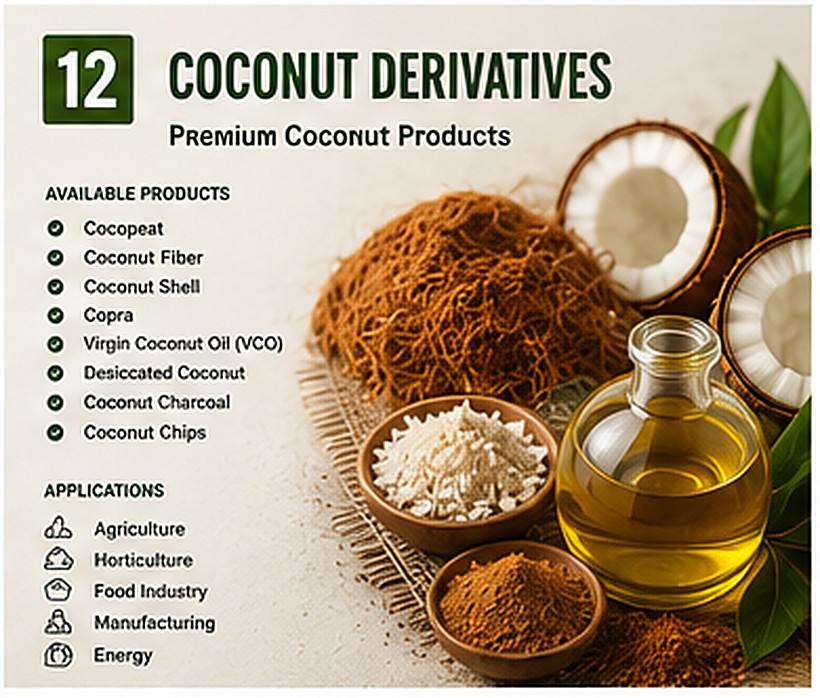
Overview
The value of the coconut to an importer is that nothing about it is waste. The kernel dries into copra for oil milling or is cold-pressed into virgin coconut oil for food and cosmetics. The flesh is shredded into desiccated coconut for bakery and confectionery. The husk separates into coir fiber for matting and rope, and cocopeat for horticulture, now one of the fastest growing lines as growers move away from peat moss. The shell is carbonised into charcoal for briquettes and activated carbon. We source all of it through one supply chain, which lets smaller buyers combine lines into one container.
Grades
Washed and buffered to low EC for direct use in horticulture, or raw at a lower price for buyers who buffer themselves.
Cold-pressed without heat or chemical refining, food and cosmetic grade, packed in drums or IBC.
Fine or medium grade, low bacterial count, for bakery, confectionery and food manufacturing.
Sun-dried or kiln-dried copra for oil milling, and graded coir fiber for matting, rope and geotextile.
Where it's grown
Post-harvest
Each line takes its own route. Copra is sun-dried or kiln-dried to around 6% moisture before milling. Virgin coconut oil is cold-pressed from fresh kernel without heat or solvent, which is what preserves the aroma and nutrient profile buyers pay a premium for. Desiccated coconut is shredded, pasteurised and dried under controlled conditions to hold bacterial counts down. Husk is decorticated to separate long coir fiber from the pith, and the pith is then washed repeatedly to strip out salts before being buffered with calcium nitrate and compressed into blocks.
Season
Coconuts fruit continuously rather than in a single harvest, so all coconut lines are available year-round with no seasonal gap. Lead time is governed by processing and drying capacity, generally two to four weeks for a container once the order is confirmed.
Who buys it
Cocopeat blocks and loose fill as a peat-free growing medium, exported worldwide.
Virgin coconut oil and desiccated coconut for food manufacturing and cosmetic formulation.
Coir fiber and coconut-shell charcoal for matting, geotextile, filtration and fuel.
Packing, shipping & documents
Packing differs by line: cocopeat in 5kg compressed blocks palletised to about 20 tonnes per 40ft, VCO in 200kg drums or IBC totes, desiccated coconut in 25kg multi-wall paper bags, copra in bulk or woven bags, and coir in pressed bales. Mixed containers combining several lines are available and are how most smaller buyers reach a full container load economically. Documentation covers certificate of origin, phytosanitary certificate where applicable, packing list, and for food lines a health certificate plus microbiological analysis.
Questions buyers ask
Yes. Mixed containers combining cocopeat, copra, VCO, desiccated coconut and coir are common, and are usually how smaller buyers reach a full container load economically.
Yes. Standard VCO is cold-pressed without heat or chemical refining, which preserves the natural aroma and nutrient content.
Washed and buffered cocopeat is supplied at low EC ready for direct horticultural use. Raw unbuffered cocopeat is available at a lower price for buyers who buffer in-house.
Yes. Coconut palms fruit continuously rather than in one harvest, so there is no seasonal gap. Lead time is two to four weeks driven by processing capacity.
Certificate of origin, packing list, health certificate, and microbiological analysis from an accredited laboratory. Phytosanitary certification is added where the destination requires it.
Let's talk tonnage
Tell us your grade, volume, and destination port. We reply within one business day with an offer, samples, and lead time.
Other commodities